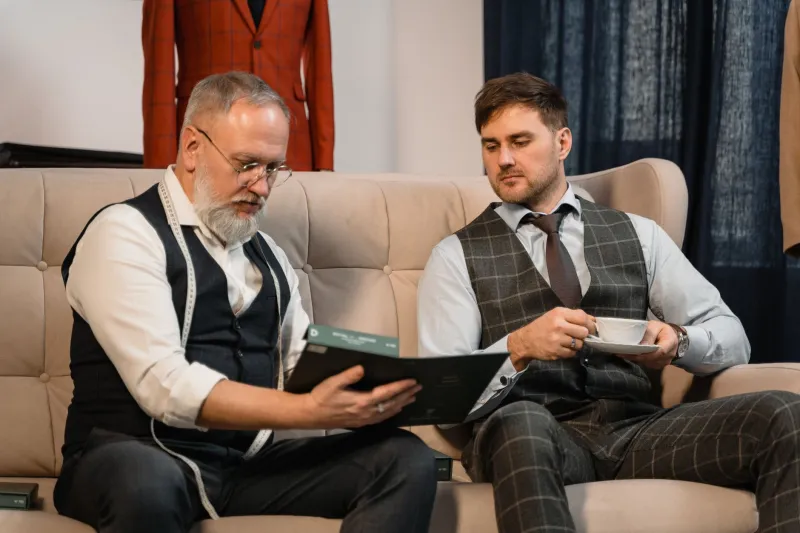
When Your Client Speaks Fluent Design: The Art of Collaborating With the Informed Expert

There is a particular kind of consultation that every experienced bespoke designer will eventually encounter — one that arrives not with a mood board and a vague feeling, but with a vocabulary. The client seated across from you uses terms like interlining, selvedge, or bias cut without hesitation. They have opinions about hand-stitching versus machine finishing. They may have spent years working in fashion, studied textile arts, or simply devoted decades of genuine passion to understanding the craft at a technical level. They are, in the truest sense, informed.
And yet, they have come to you.
This dynamic — the expert client, the knowing collaborator — is one of the most layered relationships a design studio can cultivate. It carries enormous potential and, if mishandled, an equally significant capacity for friction. At Liata Vigail Design, it is a relationship we approach with both appreciation and deliberate care.
The Gift and the Complication
There is genuine pleasure in working with a client who understands the language of design. The foundational work of translation — explaining why a particular construction method serves a garment's longevity, or why a fabric's hand matters as much as its visual weight — is already done. Conversations move faster. Decisions carry more nuance. There is a shared fluency that can elevate the entire process.
But fluency is not the same as authority. And this is where the relationship requires the most careful tending.
A client who knows a great deal about fashion construction, for instance, may arrive with strong convictions about how their commission should be executed. Those convictions are often well-founded. They may also, on occasion, conflict with the designer's own judgment about what will best serve the final piece. When both parties possess genuine expertise, the question of whose expertise governs the work becomes one that must be answered — ideally before the first pattern is drafted.
Respecting Knowledge Without Surrendering Vision
The instinct, when faced with a highly informed client, is sometimes to defer — to treat their technical knowledge as a kind of permission structure that overrides the studio's own creative perspective. This is a mistake, and a subtle one.
Deference feels like respect. It can even feel like collaboration. But in a bespoke relationship, the client has not simply purchased materials and labor. They have engaged a designer's singular point of view, their accumulated judgment, their aesthetic sensibility. To quietly abandon that sensibility in the face of an expert client is not humility. It is a disservice to the commission itself.
The more productive posture is one of engaged dialogue rather than either capitulation or defensiveness. When a knowledgeable client raises a technical concern or preference, the response should be genuine engagement: acknowledging what they bring, explaining the studio's reasoning with equal specificity, and arriving at decisions collaboratively rather than unilaterally. This requires confidence — the kind that is not threatened by a client who knows things.
Where Boundaries Become Design Tools
One of the less-discussed aspects of bespoke work is the degree to which clear creative boundaries actually protect the client's outcome. This is especially true when working with expert clients.
A client steeped in industry knowledge may be accustomed to a certain way of doing things — the methods they learned, the standards their own professional world applies. Those methods may be excellent. They may also be entirely unsuited to the specific commission at hand, or simply different from the studio's approach without being superior to it. Without clear articulation of the studio's own process and philosophy, an expert client can inadvertently redirect a project away from what made the studio worth commissioning in the first place.
Establishing the studio's creative authority early — not as a defensive act, but as a transparent one — actually gives the expert client more, not less. It gives them a genuine counterpart. Someone who will push back thoughtfully. Someone whose agreement, when it comes, means something.
The Difference Between Input and Direction
A useful distinction to hold throughout any collaboration with an informed client is the difference between input and direction. Input enriches a process. Direction controls it. Both have their place, but they are not interchangeable, and conflating them is a common source of tension in expert-client relationships.
Input from a knowledgeable client is extraordinarily valuable. They may flag a construction detail that genuinely warrants reconsideration. They may introduce a material reference the studio had not encountered. They may articulate a functional requirement with a precision that a less informed client could not. All of this makes the work better.
Direction, however — the insistence that a specific technique be used, that a particular supplier be engaged, that the studio's process conform to the client's own professional standards — is a different matter. When a client begins directing rather than contributing, the bespoke relationship has shifted into something closer to contract manufacturing. The studio's creative investment, and by extension the quality of the outcome, diminishes accordingly.
Naming this distinction openly, and doing so early in the relationship, is one of the most respectful things a studio can offer an expert client. It acknowledges what they bring while preserving what they came for.
When the Most Collaborative Relationship Requires the Clearest Limits
It may seem counterintuitive, but some of the most genuinely collaborative commissions we have undertaken at Liata Vigail Design have been with clients who arrived knowing the most. Not because expertise smoothed every decision, but because it made honest conversation possible.
An expert client can hear a direct explanation of why the studio is choosing one approach over another. They can evaluate that reasoning on its merits. They can disagree and articulate why. This kind of exchange — rigorous, specific, mutually respectful — is what genuine creative collaboration looks like. It is also, frankly, more demanding than working with a client who simply trusts without question.
The studios that navigate expert clients most successfully are those that have done the internal work of knowing, clearly and without apology, what they stand for. A designer who is uncertain of their own creative position will struggle to hold it in conversation with someone who is not. A designer who has genuine conviction — about their methods, their materials, their aesthetic standards — can engage even the most informed client from a place of security rather than anxiety.
A Relationship Worth Cultivating
For all its complexity, the expert-client relationship is one worth seeking out. It sharpens a studio's thinking. It demands a level of articulation that makes the work more conscious and, ultimately, more refined. It also tends to produce clients who become long-term collaborators — people who return not because they were simply satisfied, but because they found a creative partner equal to their own standards.
The key is to receive their expertise as a gift without mistaking it for authority. To welcome the conversation without losing the thread of your own voice within it. To understand that the client who knows your language has not come to tell you what to make. They have come, precisely because of what they know, to trust you to make it.