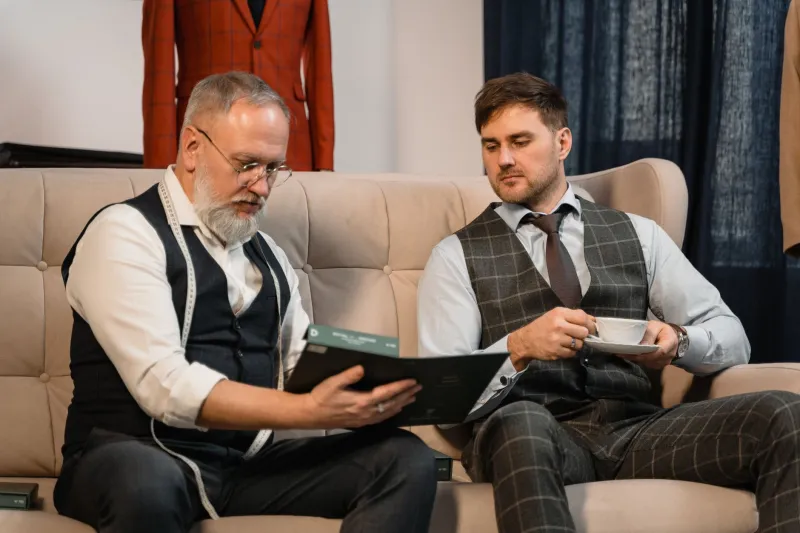
When Inspiration Becomes Interference: Guiding the Over-Referenced Client Toward Something Truly Their Own

There is a particular kind of client who arrives at the first consultation fully prepared. They have curated folders, color-coded mood boards, and screenshots pulled from every corner of the internet — fast fashion lookbooks, mass-market retailer campaigns, influencer posts tagged from three separate continents. They know, with complete confidence, exactly what they want. And therein lies the challenge.
Bespoke design, at its finest, is not the reproduction of something that already exists. It is the creation of something that could not exist without a specific person, a specific moment, and a specific creative partnership. When a client arrives tethered to references that belong to the world of mass production, the designer's task becomes considerably more layered than it might first appear.
The Difference Between Inspiration and Instruction
Inspiration is a gift. A client who arrives engaged, visually literate, and emotionally invested in the outcome is, in many respects, an ideal collaborator. The difficulty arises not from enthusiasm itself but from the nature of the references that enthusiasm produces.
A screenshot of a fast fashion garment — however beautiful in a photograph — carries with it the DNA of industrial production: standardized sizing, synthetic materials chosen for margin rather than quality, construction methods designed for speed rather than longevity. When a client presents such an image as the template for a bespoke commission, they are, often unknowingly, asking a craftsperson to translate the language of mass manufacture into the language of individual artistry. These are not the same language.
The same tension emerges in interior and graphic design contexts. A client who has spent months collecting images from algorithmically curated feeds may arrive with a vision that is, in truth, a composite of trending aesthetics rather than a coherent personal expression. The references contradict one another. The palette shifts. The proportions borrowed from one source clash with the silhouette borrowed from another. What reads as decisive on a screen reveals itself, in practice, as a collection of disconnected impulses.
Protecting the Work Without Dismissing the Client
The designer's responsibility in these moments is dual. On one hand, there is an obligation to the work itself — to the integrity of the bespoke process and the standards that define it. On the other hand, there is an equally serious obligation to the client's dignity. A person who arrives with hundreds of saved images has invested real time and genuine emotional energy in preparing for this conversation. To dismiss that preparation, however gently, risks severing the trust that makes authentic collaboration possible.
At Liata Vigail Design, the approach begins not with redirection but with genuine inquiry. Before any reference is evaluated, the question asked is: What feeling were you seeking when you saved this? Not: What do you like about this piece? The distinction matters enormously. A client who has saved an image of a heavily embellished gown from a fast fashion retailer may not, in fact, want embellishment. They may want ceremony. They may want the sensation of being seen. They may want the memory of a grandmother who dressed with formality on ordinary days. The image was simply the closest available proxy for an emotion that had not yet found its proper form.
When the conversation moves from the surface of a reference to the feeling beneath it, the entire dynamic shifts. The client is no longer defending a Pinterest board. They are articulating something far more personal, and that personal articulation is precisely the raw material from which bespoke work is made.
The Education That Happens in the Studio
There are moments, of course, when a client's attachment to a specific reference runs deeper than aesthetic preference. Some clients have been told, by well-meaning friends or by the prevailing culture of social media, that a particular trend or silhouette is definitively correct for their body type, their occasion, or their budget. Untangling this requires a degree of education that extends beyond the design process itself.
This education is not condescension. It is craft knowledge offered in service of the client's actual goals. Explaining why a particular fabric behaves differently from the polyester shown in a reference image, or why a construction technique that reads as simple in a photograph is structurally compromised in reality, gives the client genuine information with which to make genuine choices. Most people, when offered this transparency, respond not with defensiveness but with curiosity.
The studio becomes, in these conversations, a kind of translation chamber. The client brings the emotional language of their references. The designer brings the technical language of materials, construction, and proportion. The work that emerges speaks both languages simultaneously — which is, ultimately, what distinguishes bespoke from every other category of design.
When Conflict Cannot Be Dissolved
It would be dishonest to suggest that every misalignment resolves itself through conversation. There are clients whose vision is, at its core, incompatible with the standards of a bespoke studio — not because their taste is wrong, but because what they are seeking is not, in fact, what bespoke design offers. A client who wants to replicate a specific mass-market look at a specific mass-market price point is not a bespoke client. They are a retail customer, and the most respectful thing a studio can do is acknowledge that distinction clearly and without judgment.
This is not a failure of the consultation process. It is, rather, evidence that the process is working as it should. The selective studio — one that understands its own purpose and communicates that purpose with clarity — serves its clients better by defining the relationship honestly than by attempting to accommodate every request regardless of fit.
There is a generosity, too, in this clarity. A client redirected toward a better-suited option is a client whose actual needs have been honored. That kind of honesty, offered with warmth, often produces something unexpected: the client returns, later, with a commission shaped by a deeper understanding of what bespoke design truly is.
Toward a More Intentional Collaboration
The client who arrives with too many references is not a problem. They are an invitation — to slow down, to ask better questions, to move beneath the surface of the visual toward the substance of the personal. Bespoke design has always been, at its heart, an act of listening. The mood board is simply the opening sentence of a longer, richer conversation.
At Liata Vigail Design, the aim is never to diminish what a client brings to the table. It is to transform it — to take the raw material of accumulated imagery and impulse and refine it into something that could not have existed without this particular person, in this particular moment, working alongside a designer committed to the integrity of the craft.
That transformation is the work. And it begins, always, with the question beneath the image.