Before the First Stitch: The Sacred Rituals of Bespoke Fashion Creation
Most people, when they think of fashion, think of the finished object: the garment as it appears on a body, in a photograph, under light. What they rarely consider is the long, layered passage that precedes that moment—the months of conversation, contemplation, sourcing, and quiet labor that determine whether a piece of clothing becomes merely beautiful or becomes, in some harder-to-name sense, true.
Bespoke fashion creation, as practiced within studios like Liata Vigail Design, is not simply a slower version of conventional production. It is a fundamentally different mode of making—one that treats the act of design as something closer to ritual than to manufacture. Understanding what happens in those early, invisible stages illuminates why bespoke garments carry a quality that off-the-rack clothing, however refined, cannot replicate.
The Consultation as Ceremony
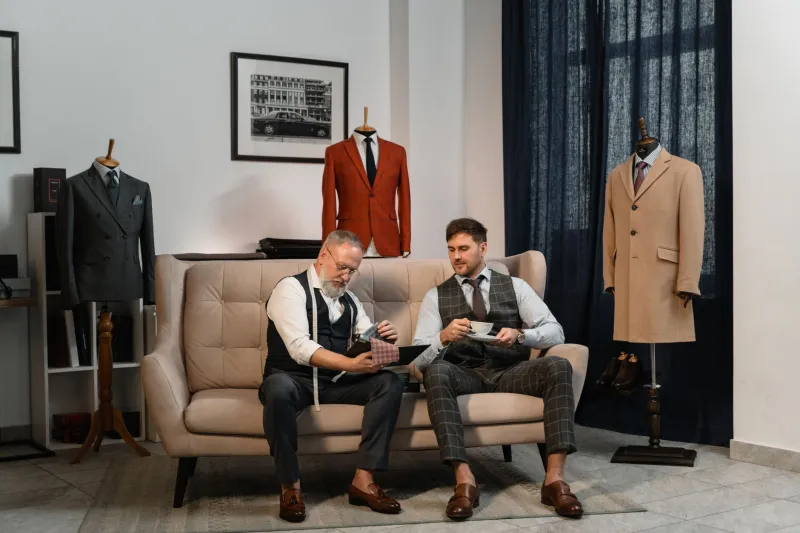
The first meeting between a bespoke designer and a new client is rarely what either party fully anticipates. On the surface, it appears to be a practical exchange: the client describes what they need, the designer listens and asks questions, and together they establish the parameters of the commission. In reality, something more complex is taking place.
A skilled bespoke designer is, in those early conversations, reading far more than the spoken brief. They are observing how a client moves through space—the natural posture, the unconscious gestures, the way fabric already drapes across the body. They are listening for the emotional subtext beneath practical requests. When a client says they need "something for important occasions," the designer is hearing an invitation to ask: What makes an occasion important to you? What do you want to feel in those moments? What do you want others to understand about you before you speak?
At Liata Vigail Design, this initial consultation is treated with the gravity it deserves. It is not scheduled between other appointments or conducted over a rushed lunch. It is given space—physical and temporal—so that the conversation can unfold at its own pace. The studio environment itself is part of this ceremony: a considered space where the visual language of the designer is legible in every detail, offering the client a kind of orientation before the work begins.
The Philosophy of Fabric Sourcing
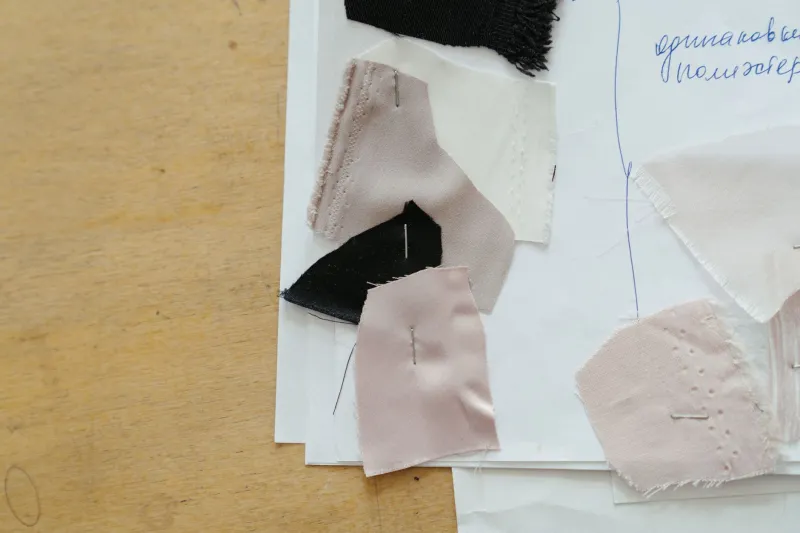
Once the conceptual direction of a commission begins to clarify, the next ritual is perhaps the most tactile: the sourcing of materials. For bespoke designers who take their practice seriously, fabric selection is never a logistical task. It is an act of curation that can take days, weeks, or, in exceptional cases, months.
The distinction between bespoke fabric sourcing and conventional material procurement lies in the specificity of intention. A bespoke designer is not searching for a fabric that meets a set of technical specifications. They are searching for a material that carries the right quality of presence—that will behave precisely as the design demands, age in ways that enhance rather than diminish the garment, and communicate something true about the person who will wear it.
This often means moving beyond domestic wholesale markets. Artisan designers sourcing for bespoke commissions may work with mills in Italy's Biella region for suiting wools, Japanese textile houses for precision-woven silks, or small American producers for heritage textiles that carry a specific regional character. The sourcing process is, in itself, a form of research—an inquiry into material culture that informs the design at every subsequent stage.
At Liata Vigail Design, fabric sourcing is understood as an extension of the client relationship. The materials selected for a commission are chosen not only for their aesthetic and structural qualities but for the story they carry—their origin, their production method, their relationship to craft traditions that predate industrial fashion.
The Sketchbook as Private Architecture
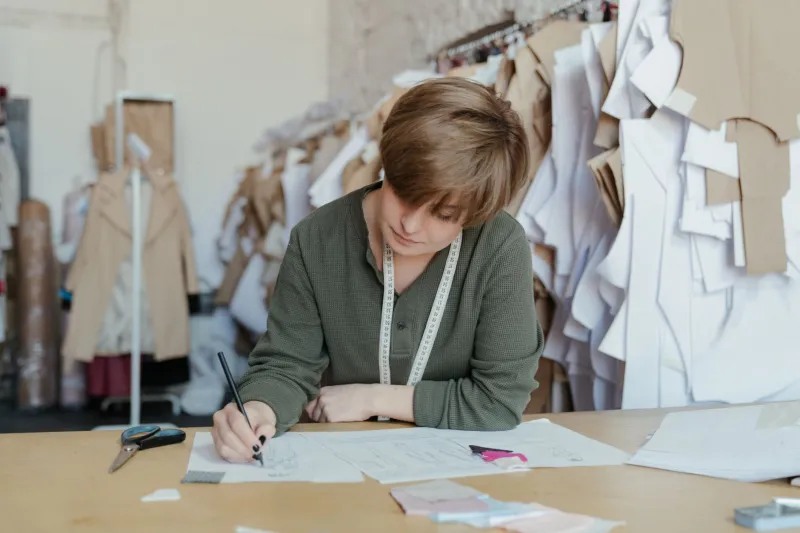
Between the consultation and the toile, there exists a stage of the bespoke process that is almost entirely invisible to the outside world: the period of private design development. For most artisan designers, this takes place in a sketchbook—a document that functions simultaneously as a visual journal, a problem-solving space, and a record of the designer's internal dialogue with the commission.
The sketches produced during this stage are rarely polished illustrations. They are working drawings—quick studies of proportion, notation on construction challenges, explorations of silhouette that are abandoned almost as soon as they are committed to paper. The value of this process is not in the individual drawings but in the cumulative thinking they represent: the gradual movement from a vague conceptual direction toward a specific, resolved design.
For designers whose practice is rooted in intentionality, the sketchbook is also a space for something less easily categorized—a kind of meditative attention to the commission that allows intuitive responses to surface alongside analytical ones. Many bespoke designers describe returning to a sketch the following morning and seeing it differently, or waking with a solution to a construction problem they had been unable to resolve the previous day. This is not mysticism. It is the natural result of sustained, unhurried attention.
The Toile: Where Concept Meets Reality
The toile—a preliminary version of the garment constructed in inexpensive fabric, typically unbleached cotton muslin—is the moment at which the abstract becomes physical. It is also, for many designers, the most revealing stage of the bespoke process.
A toile is not a prototype in the conventional sense. It is a test of the design's relationship to a specific body—an opportunity to observe how the conceptual decisions made in the sketchbook translate into three-dimensional form. The fitting of a toile is another ceremony, one that requires the same quality of attention as the initial consultation. The designer observes not only the technical fit but the client's relationship to the garment: how they inhabit it, where they hold tension, what they reach for instinctively when they look in the mirror.
These observations shape the revisions that follow. In a bespoke practice, revision is not a sign of failure. It is an integral part of the design process—the dialogue between intention and reality that ultimately produces something neither party could have specified in advance.
Finishing as Devotion
The final stages of a bespoke garment—the hand-finishing, the pressing, the careful attachment of closures and linings—are where the distinction between bespoke and even the finest ready-to-wear becomes most apparent. These are tasks that cannot be meaningfully accelerated without visible consequence. They require the kind of sustained, focused attention that industrial production is structurally unable to provide.
For bespoke designers, this final stage is often described in terms that suggest something beyond craft: a form of devotion to the work, and by extension, to the person who will wear it. Each hand-sewn buttonhole, each carefully pressed seam, is an act of intention made tangible.
This is, ultimately, what separates a bespoke garment from every other category of fashion: not the exclusivity, not the price point, not even the quality of the materials, but the density of human attention embedded in every element of its making. A bespoke garment carries, in its construction, the record of all the thought and care invested in its creation—and that, in ways that are difficult to articulate but impossible to miss, is what makes it extraordinary.