The Selective Studio: Why the Best Bespoke Designers Turn Work Away

There is a particular kind of courage required to decline work in an industry that rewards volume. For bespoke designers—those who build garments, interiors, and visual identities from the ground up, stitch by considered stitch—the decision to turn away a commission is not an act of arrogance. It is, more precisely, an act of preservation.
At Liata Vigail Design, the philosophy of intentional creation has always been foundational. Every piece crafted within this studio begins with a question: Does this project allow for genuine design integrity? When the answer is uncertain, the work does not begin. That discipline, practiced quietly and consistently, is what separates bespoke work from its more commercially convenient counterparts.
The Myth of the Accommodating Artisan
American consumer culture tends to celebrate accessibility. The phrase "the customer is always right" has been absorbed so thoroughly into the commercial imagination that designers who push back against client demands are sometimes viewed with suspicion—as difficult, precious, or impractical. But this framing misunderstands the nature of bespoke creation.
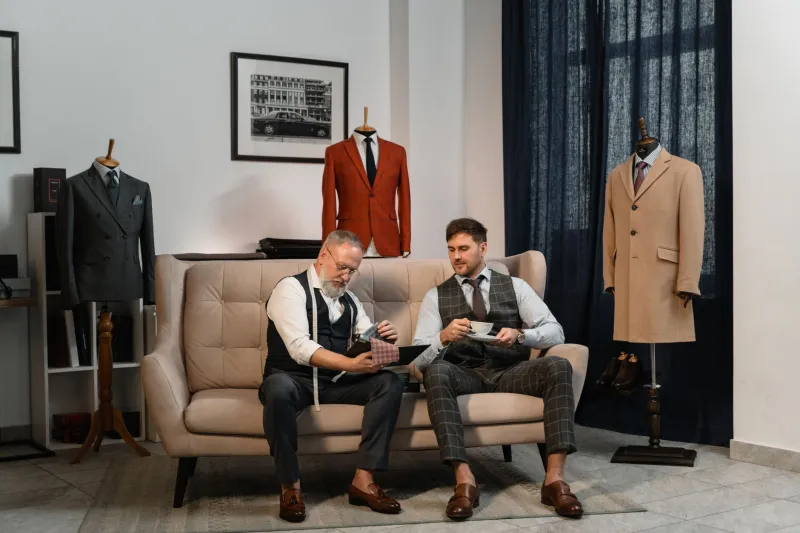
Bespoke design, by its very definition, is not a transaction. It is a collaboration in which the designer's vision, expertise, and aesthetic sensibility are as central as the client's desires. When a designer abandons that sensibility to please a client who may not share their language of form, proportion, or material, the resulting work is no longer bespoke. It is merely expensive custom production.
Independent designers working across fashion, interior, and graphic disciplines describe a familiar tension: the client who arrives with a mood board assembled entirely from another designer's work, essentially requesting replication rather than creation. "The moment someone asks me to recreate something they found elsewhere," one New York–based fashion designer noted in a recent conversation, "I know the collaboration will be misaligned. My role is not to reproduce. It is to interpret."
Non-Negotiables as a Creative Compass
Every serious bespoke designer operates with a set of non-negotiables—principles so embedded in their practice that compromising them would render the work meaningless. These might include material sourcing standards, minimum consultation timelines, or the right to make aesthetic recommendations that override a client's initial brief.
For Liata Vigail Design, intentionality is that non-negotiable. Each commission begins with a discovery process that is, at times, more investigative than conversational. The designer must understand not only what a client wants but why they want it—what emotional or functional need the piece is meant to fulfill. Without that depth of understanding, even technically flawless work can feel hollow.
When a prospective client is unwilling to engage with that process—when they arrive with fixed specifications and no appetite for dialogue—the collaboration is effectively foreclosed before it begins. In those instances, declining the commission is not a rejection of the client. It is a recognition that the conditions for meaningful work do not yet exist.
The Market Pressure Toward Mass Customization
The rise of "mass customization"—a model in which consumers select from predetermined variables to produce something notionally unique—has complicated the bespoke landscape considerably. Platforms offering monogrammed goods, configurable furniture, and algorithmically personalized garments have introduced a generation of consumers to the idea of customization without introducing them to the reality of bespoke design.
The distinction matters enormously. Mass customization is, at its core, a manufacturing model. Bespoke design is a relationship. The former optimizes for efficiency and repeatability; the latter resists both. A garment created within a true bespoke practice carries the designer's judgment in every decision—from the weight of the interfacing to the angle of a lapel—in ways that no configuration tool can replicate.
Designers who have built reputations on genuine bespoke work are increasingly aware of this confusion in the market. Clients sometimes arrive expecting the speed and flexibility of customization platforms while requesting the depth and exclusivity of bespoke creation. Navigating that expectation gap requires not only clear communication but, at times, a willingness to redirect clients toward the model that actually suits their needs—even if that means directing them elsewhere.
What Selectivity Signals to the Right Clients
Counterintuitively, the practice of saying no tends to attract precisely the clients a bespoke designer most wants to work with. When a studio is known for its standards—for the rigor of its consultation process, the clarity of its aesthetic identity, and the quality of its finished work—it draws clients who understand and value those qualities.
These are clients who arrive prepared to invest time as well as resources. They come with genuine curiosity about the design process rather than a checklist of deliverables. They understand that revision is part of refinement, not a failure of the initial brief. They are, in short, collaborators rather than consumers.
At Liata Vigail Design, the most meaningful commissions have consistently emerged from relationships built on mutual respect for the creative process. These are not always the largest projects or the most publicly visible ones. They are, however, the ones that result in work that endures—pieces that carry genuine meaning for the people who commissioned them and genuine satisfaction for the designer who created them.
Protecting Vision in a Pressured Industry
The fashion and design industries are not, by nature, environments that reward restraint. There is constant pressure to produce more, to accept more, to scale. For independent bespoke designers, resisting that pressure requires a clarity of purpose that must be actively maintained.
Saying no is, in this sense, a form of creative discipline. It is the designer's commitment to their own standards—a refusal to allow the work to become something lesser in the name of accommodation or commercial expediency. It is also, ultimately, a form of respect for the client: a recognition that they deserve work created under conditions that allow for genuine excellence, not work produced under conditions of creative compromise.
The most celebrated bespoke practitioners in American fashion and design did not build their reputations by accepting every commission that came their way. They built them by knowing, with precision and confidence, which commissions they could serve with complete integrity—and by having the discipline to decline the rest.
In the bespoke world, the work that is turned away is often as important as the work that is made.