The Beauty in the Break: Why Intentional Imperfection Is the Highest Form of Bespoke Integrity
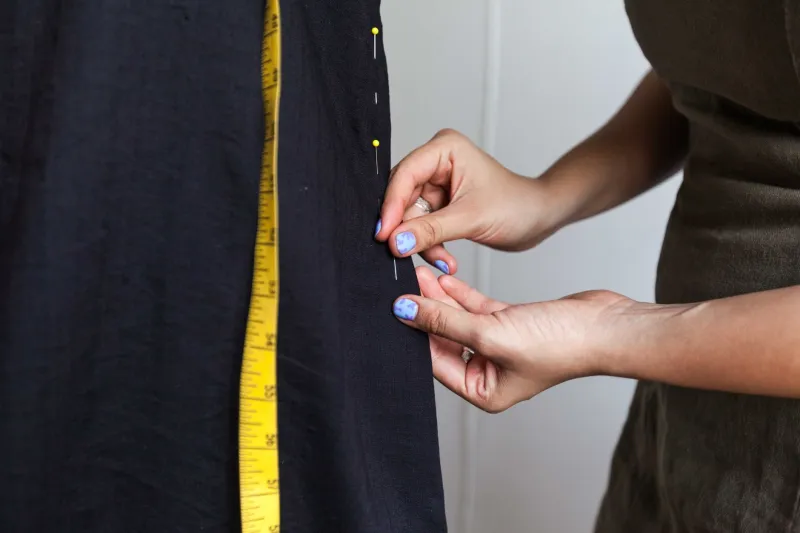
There is a particular kind of courage required to set down the seam ripper and leave well enough alone.
In an industry long governed by the pursuit of machine-like precision—straight hems, symmetrical seams, surfaces so smooth they seem to have been rendered rather than made—the deliberate preservation of a hand's natural deviation is nothing short of a radical act. Yet across the most thoughtful bespoke studios in the country, a quiet philosophical shift is underway. Designers are not merely tolerating the subtle irregularities that emerge from human hands at work. They are protecting them.
This is not a conversation about carelessness. It is a conversation about integrity.
What We Lost in the Pursuit of Perfection
The industrial revolution did not simply change how clothing was made. It changed what we believed clothing should look like. The factory floor introduced a new aesthetic standard: repetition, uniformity, the elimination of variation. Over generations, that standard migrated upward through the market until even luxury garments began to be evaluated against a mechanical ideal—as though the highest compliment one could pay a handmade piece was that it did not appear handmade at all.
The irony is profound. Clients pay a significant premium for bespoke work precisely because it is made by human hands, shaped by a specific body, informed by a living relationship between maker and wearer. And yet, for decades, the expectation was that those human hands would perform with the consistency of a programmed loom.
Something valuable was lost in that bargain. The slight variation in a hand-rolled hem. The gentle undulation of a seam pressed by an iron held by a person, not a machine. The infinitesimal asymmetry in a pair of hand-stitched lapels. These are not failures. They are evidence.
The Japanese Principle That Bespoke Design Quietly Adopted
Long before Western fashion began reckoning with this question, Japanese craft philosophy had already articulated the answer. The concept of wabi-sabi—the recognition of beauty in impermanence, incompleteness, and the organic—offers a framework that, while rooted in a distinct cultural tradition, speaks directly to what the most thoughtful bespoke practitioners are now doing in studios from New York to Nashville.
The idea is not to manufacture imperfection artificially or to romanticize sloppiness. It is to resist the compulsion to erase every trace of the human process that brought an object into being. A hand-woven textile carries the rhythm of the weaver in its structure. A hand-cut pattern piece carries the judgment of the cutter in its curves. To sand those qualities away in the name of a more polished result is, in a meaningful sense, to diminish the work itself.
Bespoke design, at its most considered, has always understood this instinctively. The finest tailors have long spoken of a garment needing to breathe—to carry a certain life within its construction. That life does not come from perfection. It comes from the honest record of how the piece was made.
What Discerning Clients Are Actually Asking For
The shift in client expectation is perhaps the most telling indicator of where bespoke culture is heading. A growing segment of the American luxury market—particularly clients who have moved beyond status-driven consumption and into a more considered relationship with the objects they commission—is actively articulating a preference for pieces that bear the marks of their making.
These are clients who have owned the machine-perfect garment. They have worn the flawless finish and found it, ultimately, forgettable. What they are seeking now is something that carries weight—not just in fabric or construction, but in presence. A piece that tells the truth about how it came to exist.
This preference is not nostalgia. It is sophistication. It reflects an understanding that the value of a bespoke commission lies not in its resemblance to a manufactured product, but in its fundamental difference from one. The slight variation in a hand-embroidered detail is not a flaw to be corrected. It is the detail's most honest credential.
How Designers Are Making Intentionality the Standard
For designers committed to this philosophy, the practical implications are significant. It requires a different kind of conversation with clients at the outset—one that frames the organic qualities of handwork not as limitations to be managed, but as characteristics to be valued.
It also requires a different relationship with one's own process. The instinct to correct, to refine, to pursue the technically perfect result is deeply ingrained in anyone trained in high-level craft. Choosing to preserve a natural irregularity demands both confidence and conviction. The designer must be able to distinguish between an imperfection that diminishes the work and one that enriches it—and then stand behind that judgment.
At Liata Vigail Design, this distinction sits at the center of the studio's creative philosophy. Bespoke design crafted with intention means, among other things, that the intention behind a given choice is legible in the finished piece. When a subtle variation in texture or line is preserved, it is not because the work is unfinished. It is because the work is honest.
Redefining the Standard of Luxury
The broader cultural conversation about authenticity is, of course, not limited to fashion. Across design disciplines—interior, graphic, object-based—there is a growing appetite for work that resists the polished anonymity of algorithmic output. In an environment increasingly saturated with AI-generated imagery and mass-produced goods that simulate handcraft without practicing it, the authentic mark of a human hand has become genuinely rare.
Rarity, as luxury has always understood, carries value. But the rarity being discussed here is not the rarity of expense or exclusivity. It is the rarity of truth. A garment or object that carries within its construction the honest evidence of how it was made—the rhythm of the hand that cut it, the judgment of the eye that shaped it—offers something that no manufacturing process can replicate.
That is the new standard of luxury. Not perfection, but integrity. Not flawlessness, but presence.
The courage to leave the mark of the hand intact is, in the end, the courage to believe that the human process of making is itself worthy of being seen. In bespoke design, that belief is not a compromise. It is the entire point.