The Mark of the Hand: Why Visible Craftsmanship Is the New Standard of Luxury
There is a particular kind of beauty that cannot be scheduled into production. It arrives unannounced, embedded in the slight irregularity of a hand-rolled hem, the gentle tonal shift where a natural dye settled unevenly across silk, the faint crease left by a craftsperson's thumb pressing fabric into form. For decades, the dominant language of luxury insisted these moments be erased. Precision was the promise. Uniformity was the proof. And yet, something important was lost in that pursuit—something that a growing number of clients across the United States are now actively seeking to recover.
At Liata Vigail Design, the philosophy has always been rooted in intention. Every piece begins not with a template, but with a conversation. And increasingly, those conversations circle back to the same quiet desire: the client wants to feel the presence of the maker in what they wear or inhabit. They want to own something that could not have been produced any other way, by any other hands, at any other moment in time.
This is not sentimentality. It is discernment.
Redefining What 'Perfect' Actually Means
The mass production model trained us to equate perfection with consistency. A garment was considered well-made if every unit off the line matched every other—same stitch count, same seam allowance, same finish. This standard served efficiency. It did not serve beauty, and it certainly did not serve meaning.
Handmade work operates under an entirely different logic. When a textile artisan cuts fabric by hand, the blade follows intention, not a pre-programmed path. When a tailor sets a sleeve by feel rather than by machine, the result reflects a judgment call made in real time—one informed by years of embodied knowledge that no algorithm can fully replicate. The minor deviations that emerge from this process are not failures of skill. They are its signature.
Consider the Japanese concept of wabi-sabi, the aesthetic philosophy that finds beauty in transience and imperfection. While the term originates outside American design culture, its sensibility has taken firm root among US collectors and clients who have grown weary of the sterile. They recognize, perhaps intuitively, that a handmade piece carries time within it—the time of its making, the attention of its maker, the irreproducible conditions of a single afternoon in a studio.
The Authenticity Problem in Contemporary Fashion
Luxury, as a concept, has suffered a credibility crisis. When a logo can be licensed, a silhouette replicated overnight, and a 'limited edition' run into the thousands, the markers that once signaled exclusivity have been hollowed out. Price alone no longer communicates rarity. Branding alone no longer communicates craft.
What cannot be faked, however, is the trace of genuine making. The slight variation in tension along a hand-stitched buttonhole. The way a natural linen shifts color at the fold because the fiber absorbed dye differently at that particular weave. The faint impression left by a tailor's chalk that was never quite fully brushed away. These details are, in the most literal sense, unrepeatable. They belong to one object, made once, by one person.
For clients who have moved beyond the performance of luxury toward its substance, these are precisely the details that matter. They function as proof—not of wealth, but of something rarer: genuine attention.
Why Bespoke Designers Protect These Moments
At a certain level of craft, the decision to preserve visible maker's marks is not accidental. It is philosophical. A bespoke designer who smooths away every trace of hand labor is, in a sense, erasing themselves from the work. They are producing an object that could, in theory, have come from anywhere.
The designers who resist this erasure understand that their clients are not simply purchasing a garment or an object. They are entering into a relationship with a specific creative intelligence—one that has a point of view, a set of values, a way of seeing the world that expresses itself through material choices and making decisions. The slight idiosyncrasies of handwork are part of that expression. To eliminate them is to diminish the conversation.
This is a perspective Liata Vigail Design holds with conviction. The work that leaves this studio is meant to be traceable—not in any documentary sense, but in the felt sense. A client should be able to run a hand across a finished piece and understand, without being told, that another hand was there before theirs.
Natural Fiber Variation as Design Element
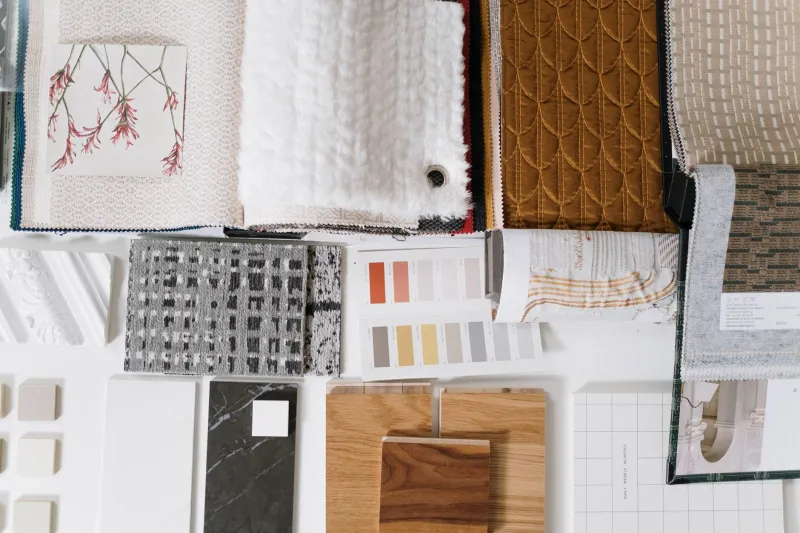
One of the most misunderstood aspects of working with natural materials is the degree to which variation is inherent to the fiber itself. Silk cultivated in different seasons carries different luster. Wool from different parts of a fleece has different hand. Linen, cotton, and cashmere all respond to dye, light, and handling in ways that are organic and, to a meaningful extent, unpredictable.
A designer who works honestly with these materials does not fight this variability. They work with it, anticipate it, and in the best cases, harness it deliberately. The result is a surface that lives—one that shifts subtly in different lights, that softens and deepens with wear, that ages into something more interesting than it began.
This is the opposite of the mass-market approach, which demands that every bolt of fabric behave identically and that every finished piece look the same under fluorescent light in a distribution warehouse. Natural fiber variation is, from that perspective, a problem to be solved. From the bespoke perspective, it is a resource to be honored.
What Clients Are Really Seeking
When a client commissions bespoke work and then pauses over the slight irregularity in a hand-rolled edge—and chooses to keep it—something meaningful is happening. They are making a declaration about what they value. They are saying, in effect, that they prefer the evidence of care over the illusion of mechanical perfection.
This is not a small shift. In a culture that has spent decades optimizing for the frictionless and the uniform, choosing the handmade imperfection is a quiet act of resistance. It is also, increasingly, a marker of genuine sophistication. Anyone can buy consistent. Not everyone has the eye—or the confidence—to recognize that the variation is the point.
At Liata Vigail Design, we have come to think of these moments not as flaws that survived the making process, but as features that define it. They are the evidence that a human being, with particular skills and a particular sensibility, made a series of choices that resulted in this specific object. No other object like it exists. No machine could have produced it. No algorithm anticipated it.
That is not imperfection. That is integrity.
And in an age of sterile precision, integrity may be the rarest luxury of all.